
Looking back, the 1972 Oscars feels like a time capsule of a changing Hollywood.
The 1972 Oscars was not just an awards show; it was a bright celebration of movies that really showed what a past era was like.
Lately, I’ve noticed that the Oscars seem to have become dull and unexciting. It feels like it’s more about showing off than truly honoring people and their accomplishments.
The real happiness and pride in celebrating others’ successes seems to have disappeared, making the event feel less genuine and memorable than it once was.


In my view, the 1972 Academy Awards was something entirely unique.
That special night was packed with unforgettable moments that raised the standard for all future Oscar ceremonies. Looking back at that evening is like stepping into a time capsule of Hollywood’s golden age – and the unedited pictures from that night tell a tale of pure glamour and star power.
So, what really made the 1972 Oscars different from the others?
A historic year
First off, the 44th Academy Awards honored some of the best films in cinema history. The French Connection ruled the night, winning five Oscars, including Best Picture, Best Director for William Friedkin, and Best Actor for Gene Hackman, who played New York City Police Detective Jimmy “Popeye” Doyle.
The film’s raw realism and thrilling car chases set a new benchmark for thrillers, and its success at the Oscars secured its spot in movie history. It was a real film with real actors and a really good story – something that seems to be lacking today.
“The film was completely different from anything I’d ever done. I’d never filmed so much outside, especially in the winter and under those conditions where we were just going for it all the time. And I don’t think I’d ever been pushed as much by a director either, which was really beneficial for me,” Gene Hackman said.

Gene Hackman was so surprised to win the award that he couldn’t even recall getting up from his chair and walking to the podium. On stage, the actor thanked his first drama coach and his mom, but soon he was filled with emotion.
Another great film, A Clockwork Orange, was also nominated that year. Stanley Kubrick’s dark vision caused both debate and praise, making the ceremony even more culturally important. At the same time, Fiddler on the Roof brought people back to musicals, delighting the audience with its beautiful music and touching story.
The Last Picture Show, directed by Peter Bogdanovich, was a coming-of-age classic that captured the hearts of viewers and received eight Academy Award nominations. With its striking black-and-white visuals, the film’s nostalgic look at small-town life really stood out. Cloris Leachman and Ben Johnson gave unforgettable performances, each winning the Oscar for Best Supporting Actress and Actor.
No hotpants in sight
The 1972 Academy Awards marked a dazzling return to the glitz and glamour of Hollywood’s golden era.

The feathers, fringe, and hippie headbands that had been popular in past ceremonies were gone. This year’s gala featured a beautiful display of vintage style, with stars dressed in flowing chiffons and fancy brocades, highlighted by diamonds and furs.
Some reporters pointed out that there were no hotpants outfits to be seen, although Jane Fonda made a bold choice by wearing one of the few pant suits on the red carpet.
Another reporter mentioned that many of the women showed off “plenty of cleavage,” which added to the glamorous vibe of the evening.
Protests
As usual, the area outside the Los Angeles Music Center was filled with fans excited to see the star-studded parade heading to the awards ceremony.
But the excitement was mixed with some tension, as protests broke out nearby — something that happened often back then. Demonstrators, who were said to be quite loud, were kept back by a line of police officers.
That year, the protests were focused on Clint Eastwood’s Dirty Harry, which, even though it wasn’t nominated for any awards, was criticized for supposedly glorifying police violence. One particularly eye-catching sign said, “Dirty Harry is a Rotten Egg.”
Shirtless & covered in chains
Music played a big part in making the 1972 Oscars unforgettable.
Isaac Hayes made history as the first African American to win an Oscar for Best Original Song with his hit “Theme from Shaft,” bringing soul music to the Oscars like never before.
His amazing performance on stage was one of the best parts of that April night. The icon, shirtless and wearing chains, took over the stage as he played the keyboard, surrounded by a flurry of dancers.
The show hit its high point when Hayes vanished under the stage in a cloud of smoke, leaving the audience amazed. It was a moment that really showed the magic of the Oscars!
Betty Grable’s farewell
One of the best moments of the night was when the famous actress Betty Grable attended the gala, making one of her last public appearances.
Betty Grable was — and still is — one of Hollywood’s legends. Her famous bathing-suit poster, made in 1943, shot her to fame as the top pin-up girl of World War II. But Grable was more than just a pretty face; she was a very successful actress, with her 42 films in the 1930s and 1940s earning over $100 million.

In the mid-1940s, she was the highest-paid woman in America, famously insuring her legs for $1 million. Looking back on her amazing journey in film, Grable once said, “I became a star for two reasons, and I’m standing on them.”
Betty Grable showed up in a stunning turquoise dress, beautifully decorated with silver sparkles and featuring a classy neckline.
Sadly, the 1972 Oscars were one of her last public appearances, a bittersweet moment for her fans who loved her. Tragically, she died just a year later from lung cancer at the age of 56.
A frail, white-haired pioneer
Among the famous faces at the 44th Academy Awards, one person stood out the most. At the end of the nearly three-hour-long awards show, a frail, white-haired film pioneer made a surprise appearance. It was none other than Charlie Chaplin, who had been kicked out of Hollywood and the U.S. two decades earlier after being accused of being a communist sympathizer.

The moment was super emotional when Chaplin received an award for his work in movies. The 82-year-old actor walked onto the stage with his famous derby cane, and the crowd of 2,900 celebrities gave him a huge round of applause.
Actually, the standing ovation went on for 12 minutes, which is the longest ever at the Academy Awards.
For the millions watching from home, seeing this movie legend in person felt almost unreal. But the most touching part was when Chaplin got the special award from the Academy of Motion Picture.
“Oh, thank you so much. This is such an emotional moment for me. Words just don’t seem enough. Thank you for inviting me here. You are all wonderful, sweet people,” the English comic actor expressed.
Old and new
As mentioned, the 1972 ceremony was a celebration of both old and new Hollywood coming together.
Famous stars like Jane Russell, Macdonald Carey, and Jane Powell Kelly shared the stage with the new generation of actors like Jane Fonda, Jack Nicholson, Gene Hackman, Cloris Leachman, and Raquel Welch.
The red carpet was a sight of pure elegance, with stars wearing glamorous dresses and tuxedos that showed off the classic charm of Hollywood’s golden age.
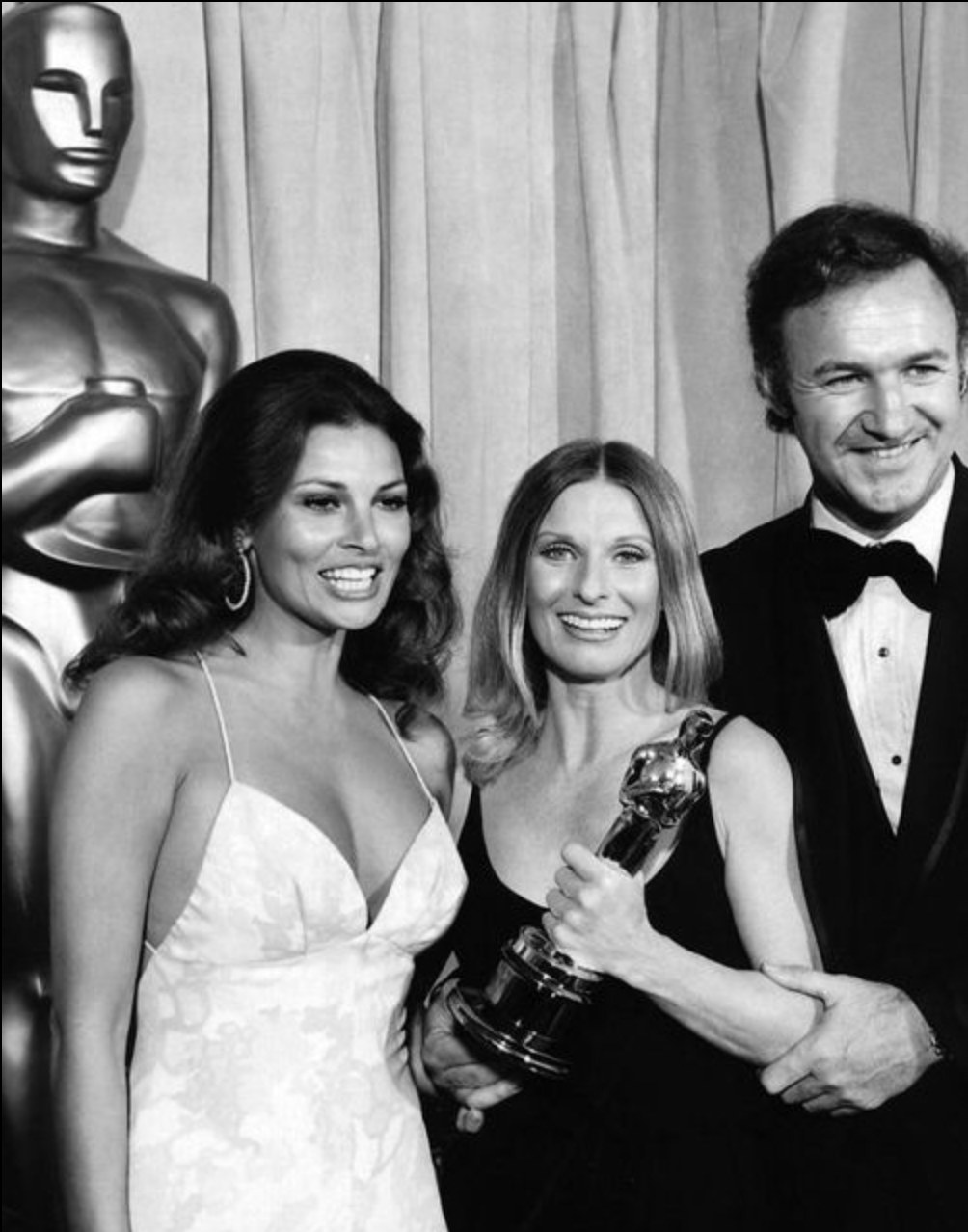
There are definitely many pictures from that night that show the exciting atmosphere. But one picture really stood out to me: the one with Raquel Welch, Cloris Leachman, and Gene Hackman together.

Gene Hackman looked really happy in this picture, especially since Cloris Leachman had just won the Best Supporting Actress award for The Last Picture Show, and Raquel Welch looked amazing in her beautiful dress. At the 1972 Oscars, Welch was not only there to present the Best Supporting Actress award, but she also showed how ideas about femininity in Hollywood were changing. Her confidence and style in the photo represent a time when women started to make their mark in the film industry.
Behind the picture
To me, this photograph captures not just a moment but also highlights the careers and contributions of three important people in the film world. Each person in the picture shows a different part of Hollywood’s growth.
For instance, Leachman’s acting is a great example of how films were changing during that time. Her win was a sign that Hollywood was starting to focus more on deeper, character-driven stories.
The image of Hackman, Leachman, and Welch also shows the bigger cultural changes happening in the early 1970s. The film industry was moving away from old-fashioned stories and starting to tell more diverse tales, which was clear in the films that were nominated that year.

Whether through the lens of the camera or the echo of applause, the 1972 Academy Awards will forever hold a special place in cinematic history!