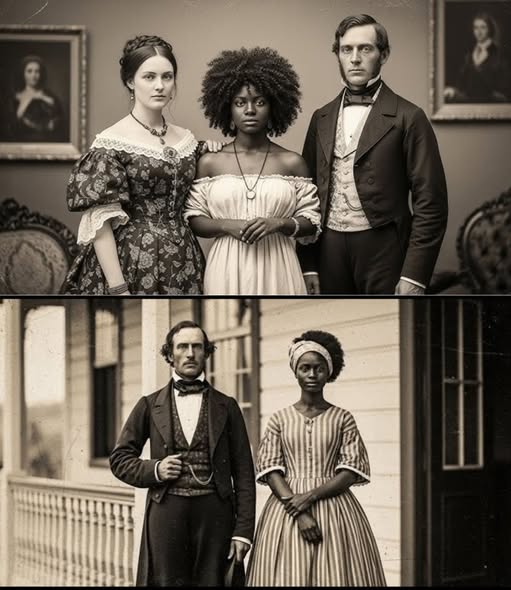
On the morning of March 15, 1839, Thomas Whitmore stood in the doorway of the slave quarters at Riverside Plantation, Caroline County, Virginia, and felt his certainty collapse.
He had risen early, long before breakfast, intending to inspect the young woman he had purchased the previous afternoon in Richmond. It was a practical matter, he told himself. He needed to justify the extraordinary sum of $750, a price that exceeded anything he had ever paid for human property.
But when the woman stepped into the pale light of dawn and turned her face toward him, Thomas Whitmore understood—instantly and irrevocably—that something was terribly wrong.
His hands began to shake, not from lust, not from pride, but from recognition.
The resemblance was impossible to ignore.
The shape of her face.
The angle of her cheekbones.
The steady, unflinching way she held her head.
They belonged to Catherine Whitmore, his late wife, dead for three years.
And as memory collided with rumor, dates, and buried family secrets, Thomas realized the devastating truth:
The enslaved woman he had just purchased at public auction was not merely similar to his wife.
She was his wife’s daughter.
A Respectable Man by the Standards of His Time
Thomas Whitmore was forty-two years old, a widower, and the owner of a modest tobacco plantation worked by eighteen enslaved people. In Caroline County, he was regarded as respectable—churchgoing, punctual with debts, outwardly restrained.
He did not whip enslaved people himself. That task was left to his overseer, Jacob Pierce, whose cruelty Thomas pretended not to see. This, in his mind, was evidence of moral distance.
He had two children by his marriage to Catherine:
Richard, twenty, studying law in Richmond.
Margaret, seventeen, recently courted by a neighboring planter’s son.
Thomas considered himself a Christian gentleman, which in 1839 Virginia meant believing slavery was regrettable but necessary, cruel but ordained, immoral in theory yet acceptable in practice.
That illusion would not survive the week.
The Auction He Never Intended to Attend
Thomas had gone to Richmond for routine business. The monthly slave auction was not on his list. His labor force was sufficient. His finances were strained.
Then the young woman was brought onto the platform.
The auctioneer announced her name as Sarah, estimated age nineteen or twenty. She stood straight, eyes forward, refusing the posture of submission expected of enslaved women.
Her complexion was light enough to stir murmurs among buyers.
“Likely one-eighth,” someone whispered.
The auctioneer laughed. “Troublesome,” he said. “Sold three times in two years. Sharp tongue. Won’t submit. But gentlemen—look at her. A man with a firm hand could make her very valuable.”
The bidding began at $300.
Thomas told himself he was bidding for his household. For appearances. For practicality.
The price climbed rapidly.
When it ended at $750, Thomas realized he had spent nearly a third of his annual profit on impulse.
As he signed the bill of sale, Sarah lifted her eyes and looked directly at him.
He looked away first.
Recognition in the Morning Light
The next morning, standing in the slave quarters, Thomas saw clearly what he had missed the day before.
Sarah’s hazel eyes—nearly golden—were Catherine’s eyes.
Her posture mirrored the portrait that still hung in his study.
And with that recognition came memory.
Catherine’s two-year stay at her uncle’s plantation in South Carolina.
Her return, pale and withdrawn.
The hurried marriage.
The whispered gossip he had dismissed as cruelty.
Rumors that an infant girl had been quietly sold to a trader in Charleston.
Rumors that Catherine had been kept secluded for months.
Thomas felt the structure of his life give way.
“You Know Who My Mother Was”
“Who was your mother?” Thomas asked, his voice barely audible.
Sarah smiled—not kindly.
“You already know,” she said. “I can see it in your face.”
She explained calmly, methodically, as if delivering testimony.
Her mother had never forgotten her.
Money had been sent when possible.
Letters passed through trusted hands.
Names were spoken.
When Catherine died, Sarah made a vow.
She would find the man who married her mother and lived comfortably on land worked by people like her.
And she would force him to see her.
She had made herself difficult to sell.
Valuable enough to attract attention.
Troublesome enough to move frequently.
She had waited for Richmond.
She had positioned herself in the light.
She had ensured he could not resist.
A Legal and Moral Trap
Thomas collapsed onto a crate.
“What do you want?” he asked.
Sarah did not hesitate.
She wanted recognition.
She wanted truth.
She wanted his church, his neighbors, his children to know what slavery had done to her life.
She wanted him to feel what it meant to own blood as property.
And then she waited.
A Household on the Edge of Collapse
Over the following weeks, Thomas could neither expose nor conceal the truth.
He moved Sarah into the house as a personal servant.
He gave her privileges that drew attention.
He spoke to her in private, haunted by Catherine’s letters and deathbed confessions.
Margaret noticed.
Richard noticed.
Richard confronted his father directly.
“She looks like Mother,” he said. “If this is some indecent arrangement, end it.”
Thomas could not explain.
Because how does a man explain that the law recognizes his daughter as property?
A Crisis of Conscience
Thomas began reading abolitionist pamphlets in secret.
He attended Quaker meetings in neighboring counties.
For the first time, slavery stopped being an abstract system and became a personal crime.
Six months after the purchase, Thomas did the unthinkable.
He filed papers to manumit Sarah.
In 1839 Virginia, this was dangerous.
Freed people were required to leave the state within one year or face re-enslavement.
Neighbors arrived furious.
Other planters demanded explanations.
His reputation collapsed.
Thomas claimed Sarah was “more trouble than she was worth.”
No one believed him.
The Truth Comes Due
Before Sarah was forced to leave Virginia, she made one final demand.
“Tell your children,” she said. “Tell them I am their sister.”
Thomas obeyed.
Margaret fainted.
Richard raged.
But something unexpected followed.
Margaret sought Sarah out.
They sat together in silence.
They spoke of their mother.
They discovered that Catherine had written letters every month for nineteen years.
Love had existed—just not courage.
Departure and Consequence
Sarah left Virginia in April 1840.
She settled in Philadelphia, worked as a seamstress, married a free Black printer, and raised children born free.
Thomas never purchased another enslaved person.
Richard later fought for the Union.
Margaret and Sarah exchanged letters for decades.
Their story survives in court filings, church records, private correspondence, and the quiet spaces where law and morality collided.
Why This Story Still Matters
This is not a tale of sentiment.
It is a case study in American slavery law, property rights, inheritance, sexual violence, and moral contradiction.
A system so corrupt that a man could unknowingly purchase his own stepdaughter—and the law would see nothing wrong.
That is the devastating truth that shattered Thomas Whitmore’s world.
And it is why this story refuses to fade into history.