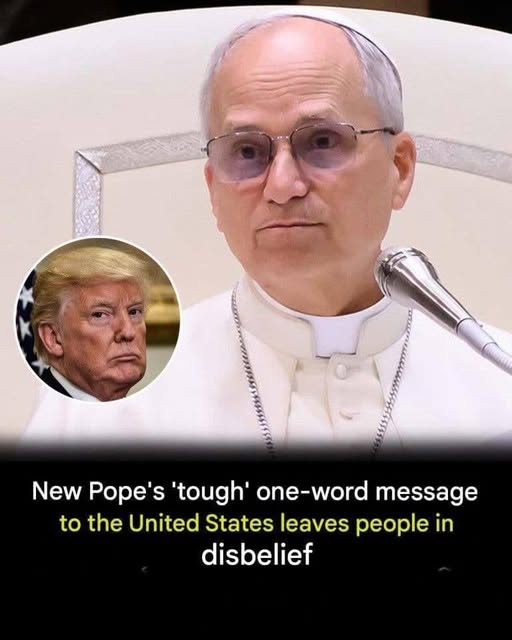
In today’s fast-paced media environment, even the briefest public statements can capture worldwide attention. When a prominent global leader speaks—especially someone in a role that carries spiritual, cultural, and diplomatic significance—every word may be examined closely. This reality became evident shortly after the beginning of the papacy of Pope Leo XIV, whose concise response to a journalist’s question quickly became a widely discussed moment across news outlets and social media platforms.
During a press conference held on May 12, only days after assuming leadership of the Catholic Church, the Chicago-born pontiff was asked whether he had a message specifically for the United States. After pausing briefly, he smiled and responded with a single word: “Many.” He then concluded with a simple blessing, saying, “God bless you all.”
Though brief, the comment ignited widespread conversation. Supporters praised the thoughtful restraint behind the response, while others speculated about what deeper meaning might lie behind the word. The moment quickly circulated online, prompting discussions about leadership, communication, and the evolving role of the papacy in a globalized world.
This article explores why such a short remark generated so much attention and what it may reveal about the broader responsibilities of modern religious leadership.
The Beginning of a New Papacy
The election of a new pope always attracts significant international interest. As the leader of the Roman Catholic Church, the pope serves as a spiritual guide to more than a billion Catholics worldwide and plays an influential role in global humanitarian, ethical, and cultural conversations.
When Pope Leo XIV began his papacy, observers around the world were eager to learn more about his priorities, perspectives, and leadership style. His background—being born in Chicago in the United States—added another dimension to the global attention.
American-born popes have historically been rare, and his personal connection to the United States created additional interest in how he might approach issues affecting American society and international relations.
Within days of taking office, journalists and commentators began closely following his public appearances, looking for clues about how his papacy might unfold.
The Press Conference That Sparked the Conversation
The moment that sparked global discussion occurred during a press conference in which journalists were invited to ask questions about the early days of the new papacy.
As the conversation progressed, one reporter asked whether the pope had a specific message for the United States. The question was straightforward but carried broad implications, given the country’s political influence, cultural diversity, and prominent Catholic population.
Rather than delivering a lengthy statement, the pope paused for a moment, smiled gently, and replied with the word “Many.” He then added a brief blessing for the audience.
Although the response lasted only a few seconds, it quickly captured attention online. Video clips of the exchange were shared across social media platforms, where viewers began offering their interpretations.
Why a Single Word Attracted So Much Attention
At first glance, it may seem surprising that a single word could generate extensive discussion. However, several factors contributed to the moment’s impact.
1. The Power of Concise Communication
Short statements often invite interpretation. When leaders provide brief responses instead of detailed explanations, audiences sometimes search for deeper meaning in what was said—and what was not said.
In this case, the word “Many” suggested that the pope might have numerous thoughts or messages related to the United States, without specifying exactly what they were.
2. Timing Early in a New Papacy
Because the comment occurred shortly after the start of the new papacy, many observers were eager for insights into the pope’s perspective on global issues. Even minor remarks can carry symbolic significance during the early days of leadership.
3. Global Attention on Religious Leadership
Popes often address topics that extend beyond strictly religious matters, including humanitarian concerns, social justice, migration, environmental stewardship, and international peace. As a result, audiences sometimes interpret papal comments within the context of broader global conversations.
A Tradition of Thoughtful Public Messaging
Throughout modern history, popes have used public statements to encourage reflection rather than simply deliver direct instructions. This tradition of thoughtful communication allows religious leaders to address complex topics in ways that encourage dialogue.
For example, previous pontiffs—including Pope Francis—have frequently spoken about compassion, social responsibility, and the importance of caring for vulnerable communities.
Short statements or symbolic gestures can sometimes carry profound meaning precisely because they encourage individuals to think carefully about their values and responsibilities.
Observers who interpreted the word “Many” as intentionally reflective suggested that the pope might have been acknowledging the complexity of the relationship between faith, society, and public life.
The Pope’s Background and Perspective
The personal background of Pope Leo XIV has also played a role in shaping public interest in his remarks.
Growing up in the United States, he experienced firsthand the cultural diversity and social debates that characterize American society. This perspective may influence how he approaches conversations about community, compassion, and global cooperation.
At the same time, the pope’s responsibilities now extend far beyond any single nation. As the leader of a global church, he must address issues affecting people across continents and cultures.
This dual perspective—understanding American society while serving a worldwide community—adds depth to the discussion about his brief message.
Interpretations from Around the World
Following the press conference, commentators and analysts offered a range of interpretations.
Some viewed the response as a simple acknowledgment that many topics deserve thoughtful discussion. Others suggested it reflected humility, indicating that the pope preferred to speak through actions and longer reflections rather than quick sound bites.
Many supporters praised the remark as an example of careful communication in an era often dominated by rapid and sometimes polarized commentary.
Rather than providing a lengthy response that might have been interpreted politically, the pope’s concise statement allowed people from different backgrounds to reflect on its meaning in their own ways.
Social Media’s Role in Amplifying the Moment
The rapid spread of the video clip highlights the growing role of social media in shaping global conversations.
Platforms such as video-sharing sites and messaging networks enable short moments from public appearances to reach millions of viewers within hours. This environment can transform even small interactions into widely discussed events.
In the case of the pope’s comment, viewers shared the clip alongside personal reflections about leadership, faith, and communication.
Some praised the calm and thoughtful tone of the response, while others expressed curiosity about what additional messages might follow in future speeches or writings.
The Broader Message of Unity and Reflection
Although the original response consisted of only one word, the pope’s closing blessing—“God bless you all”—added an important element of unity.
Blessings in public settings often serve as reminders of shared humanity and compassion, values that are central to many religious traditions.
For many viewers, this closing phrase reinforced the idea that the moment was less about delivering a specific political message and more about encouraging goodwill and reflection.
Leadership in an Age of Instant Communication
The discussion surrounding the pope’s brief response also highlights the challenges of leadership in an age when communication travels instantly across the globe.
Public figures must navigate an environment in which every comment may be recorded, shared, and interpreted by diverse audiences with different perspectives.
In such an environment, brevity can sometimes be a deliberate strategy. Short statements may help avoid misunderstandings while still acknowledging important questions.
The response from Pope Leo XIV demonstrates how even minimal communication can spark thoughtful dialogue when delivered with sincerity.
What May Come Next
As the new papacy continues, observers expect the pope to address a variety of global topics in greater detail through official speeches, written messages, and international visits.
Future addresses may explore issues such as humanitarian aid, social unity, environmental responsibility, and the role of faith in modern society.
For now, the single-word response remains a memorable early moment of the papacy—a reminder that sometimes the most powerful messages are those that encourage reflection rather than immediate conclusions.
Conclusion
The viral moment involving Pope Leo XIV illustrates how even a brief comment can capture worldwide attention when it touches on themes that resonate broadly.
By responding to a question about the United States with the word “Many” and a blessing, the pope created space for thoughtful interpretation rather than offering a definitive statement.
In an era of rapid communication and constant commentary, such moments can encourage audiences to pause and reflect on deeper values such as compassion, unity, and shared responsibility.
Whether the remark was intended as a subtle reflection or simply a concise response to a complex question, it succeeded in sparking meaningful conversation across cultures and communities.
As the papacy continues to unfold, the world will undoubtedly hear many more messages from the new pontiff. For now, however, this brief exchange serves as a reminder that leadership often involves not only speaking clearly—but also leaving room for thoughtful dialogue.