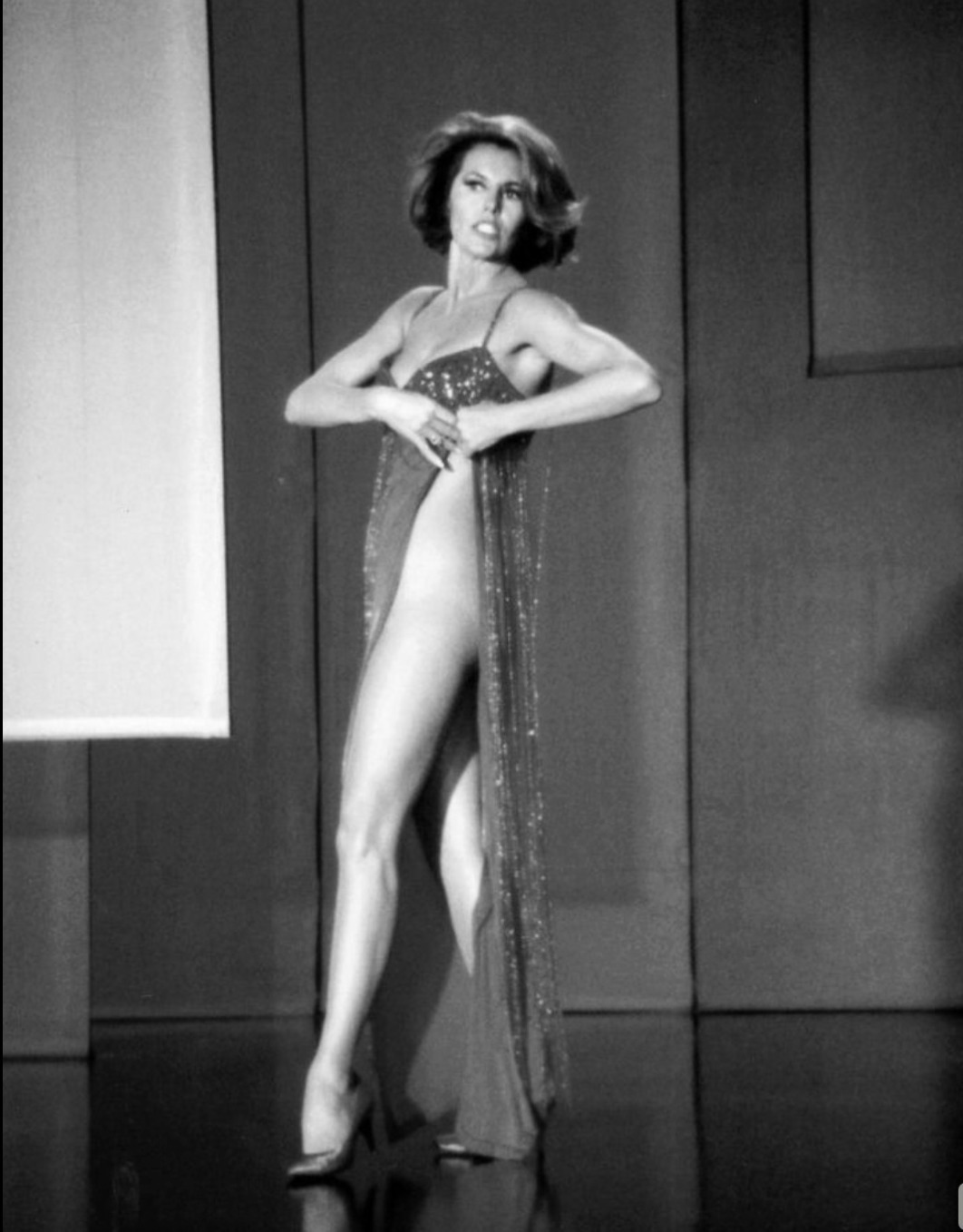
Cyd Charisse was a true triple threat — she could sing, act, and dance like a goddess.
And her legs? Nothing short of legendary.
During Hollywood’s Golden Age, she represented grace, elegance, and the pinnacle of physical artistry.
Once a frail and sickly girl,
Women like Cyd Charisse will forever be cherished for their contributions to cinema. As the stars from that golden era fade away, it’s a bittersweet reminder — that period truly displayed a level of talent we might never witness again.
The beauty from Texas exuded pure class — a genuine lady, graceful, kind, and effortlessly stunning.
With her long, sculpted legs, enchanting gaze, and natural mastery of the dance floor, Cyd Charisse secured her spot among Hollywood’s finest dancers, standing alongside legends like Fred Astaire and Gene Kelly.
However, her journey to fame was anything but simple, and the narrative of her life is as fascinating as the characters she portrayed on screen.

Born Tula Ellice Finklea on March 8, 1922, in Amarillo, Texas, Charisse encountered challenges early on, as she was a frail child. Her older brother, who struggled to pronounce “Sis,” gave her the nickname “Sid.” Later, producer Arthur Freed modified it to the spelling we recognize today: “Cyd.”
After suffering from polio, which left her weak as a child, Cyd’s parents decided to enroll her in ballet lessons to help strengthen her physique.
“I was skinny, and it seemed like a good way to build me up,” she remarked.
This therapy ignited a lifelong love for dance, influencing the course of her future.
The allure of her screen presence
By her teenage years, Tula’s abilities had already attracted the attention of leading dance instructors. She relocated to Los Angeles to study under Adolph Bolm and later trained in London and Paris, refining her skills at esteemed ballet schools. During this period, she played around with stage names — initially taking on “Felia Sidorova” to highlight a Russian ballet image, and ultimately choosing “Cyd Charisse,” which combined her childhood nickname with her married name.
Charisse’s initial foray into film was through dance rather than speaking roles. She made an uncredited appearance as a ballet dancer in Something to Shout About (1943) and continued to take on minor roles as a background dancer. However, her grace, beauty, and captivating screen presence did not go unnoticed.

MGM saw her talent and signed her at a time when studios were nurturing their own dance stars. Although she was initially cast in smaller films, she stole the limelight when she performed alongside Gene Kelly in Ziegfeld Follies (1945). Even in a short role, her graceful movements and natural rapport with Kelly attracted attention.
Her pivotal moment arrived in Singin’ in the Rain (1952). Even though she had no spoken lines, her performance in the “Broadway Melody” segment, dressed in a sparkling green gown with her dark hair flowing and legs appearing endless, became one of the most memorable scenes in musical cinema.
Fred Astaire or Gene Kelly?
Charisse frequently mentioned that movement enabled her to express emotions more effectively than words could. Standing at 5 feet 6 inches, she looked statuesque in heels and full-length stockings, gliding with extraordinary grace. Her impeccable features and shiny black hair further enhanced her image of perfection.
Her partnership with Fred Astaire in The Band Wagon (1953) illustrated this belief. Their “Dancing in the Dark” sequence highlighted her ideal combination of subtlety, romance, and technical skill — earning Astaire’s admiration as “beautiful dynamite.”

In contrast to many dancers who depended solely on speed or technical prowess, Charisse blended the elegance of ballet with dramatic expression. Her expertise in jazz, modern, and classical dance styles showcased her versatility. When asked if she preferred dancing with Fred Astaire or Gene Kelly, Cyd Charisse responded:
“I’d say they were the two greatest dancing personalities ever to grace the screen. Each has a unique style and is a delight to work with. But it’s like comparing apples and oranges — they’re both equally wonderful.”
Cyd Charisse’s husband
Away from the spotlight, she was recognized for her professionalism and discretion, avoiding Hollywood’s infamous party scene. Her dedication to her craft garnered her great respect from peers and choreographers alike.
As the golden age of movie musicals faded in the 1960s, Charisse shifted to television and stage performances, making guest appearances on variety shows and starring in Broadway productions like Grand Hotel in the 1990s. She also toured with her husband in a nightclub act, demonstrating that her grace and talent could enchant audiences well into her seventies.

Her achievements were officially acknowledged when she was awarded the National Medal of Arts in 2006 by President George W. Bush, along with an honorary doctorate from the University of North Carolina School of the Arts.
Cyd Charisse tied the knot with singer Tony Martin in 1948, and their marriage lasted over sixty years until her death. They met in a classic Hollywood manner.
“Well, he had an agent — Nat Goldstone — and I also had the same agent. Nat introduced me to Tony, and there happened to be a popular foreign film showing in town that everyone was eager to see. He invited me to go with him, and that’s how we started dating,” Cyd recounted in an interview with the Television Academy.
When tragedy struck
Together, they had one child, and Charisse also had a son from a previous marriage. Despite her glamorous public persona, her personal life was largely kept private, stable, and devoid of scandal — a rare accomplishment in Hollywood.
However, tragedy struck Cyd Charisse’s family on May 25, 1979, at the beginning of the Memorial Day weekend, when American Airlines Flight 191 crashed just outside of Chicago.
The flight, which was headed from O’Hare to L.A., lost an engine shortly after takeoff and fell into a suburban trailer park in Des Plaines, Illinois, resulting in the deaths of all 258 passengers, 13 crew members, and two individuals on the ground.
Among the victims was Sheila Charisse, the 36-year-old spouse of Nico Charisse, Cyd’s son from her first marriage.

The crash was the most lethal civilian air disaster in U.S. history prior to 9/11, and it significantly undermined the flying public’s trust in the DC-10. The aircraft was quickly mostly assigned to cargo operations, where it continues to operate both domestically and internationally. Today, the sole memorial for the 273 lives lost is a weathered banner located near the crash site — a somber reminder of that tragic day.
Nico Charisse, the husband of Sheila, had a distinctive upbringing in Hollywood. He was born to Cyd Charisse and her first spouse, Nico Charisse Sr., who was a considerably older dance instructor. After Tony Martin married Cyd in 1948, Nico Jr. was almost adopted by him. With a new half-brother, Tony Martin Jr., and caring, healthy parents, Nico Jr. was raised in a stable, drama-free Hollywood environment—something quite uncommon in the industry.
In the late 1960s, Nico met Sheila Marie Snodgrass. They tied the knot, and life appeared to be full of potential. Nico had just been accepted into the California Bar in 1977 and was starting his journey as a lawyer. However, just two years later, the family’s life was turned upside down when Sheila perished in the Flight 191 disaster.
The tragedy not only claimed lives but also left a lasting impact on Cyd Charisse and her family — a sorrowful reminder that even those enveloped in Hollywood glamour are not immune to misfortune.
Cyd Charisse cause of death
Cyd Charisse passed away on June 17, 2008, at the age of 86, due to a heart attack.
While her death signified the conclusion of an era, her influence continues to motivate dancers and performers around the globe.
Her legacy transcends the films she appeared in — she transformed the perception of what it meant to be a female dancer in Hollywood. She was never merely a supporting figure; she frequently became the emotional and visual focal point of her films, blending athleticism, elegance, and expressive artistry.
Even decades later, audiences and critics continue to be amazed by her performances.

Whether it’s the sensual confidence she radiated in Singin’ in the Rain or the romantic sophistication of The Band Wagon, Cyd Charisse remains an enduring icon — a performer whose language was movement and whose legacy continues to dance on. Share this story to honor her.